terça-feira, 29 de abril de 2014

São Paulo — Georgia, no metro
São Paulo — Georgia, on the subway


A casa onde estive alojada em São Paulo ficava junto ao aeroporto de Congonhas, num bairro tranquilo. Para me deslocar até ao centro da cidade precisava de recorrer aos transportes públicos, primeiro o autocarro e depois o metro. Foi numa dessas viagens, a caminho do Museu da Língua Portuguesa, que conheci a Georgia, uma leitora acérrima. "Leio muito! Leio um livro atrás do outro", disse-me. E as longas viagens até ao trabalho alimentam o vício, já que as aproveita para ler. O livro que naquela manhã estava quase a acabar intitulava-se "Julieta Imortal", de Stacey Jay, um romance baseado na obra de Shakespeare, mas que vira do avesso a história de amor entre Romeu e Julieta. Os romances são precisamente o estilo literário que a Georgia prefere, mas fica o aviso: "Não gosto de romance água com açúcar". 

***
The house I stayed in São Paulo was near the Congonhas airport, in a peaceful neighborhood. To go downtown I needed to catch public transports, first a bus and then the subway. It was on one of those journeys, on the way to the Portuguese Language Museum, that I met Georgia, a  fierce reader. "I read a lot! I read a book after another", she told me. And the long journeys on public transports to go to work feed the addiction, since she takes profit of them to read. The book she was nearly finishing that morning was entitled "Juliet Immortal", from Stacey Jay, a novel based on the work of Shakespeare, but that turns Romeo and Juliet love story upside down. The novels are precisely the literary style that Georgia prefers, but she left me a warning: "I don't like sappy novels".

sexta-feira, 25 de abril de 2014

São Paulo — António & Murakami


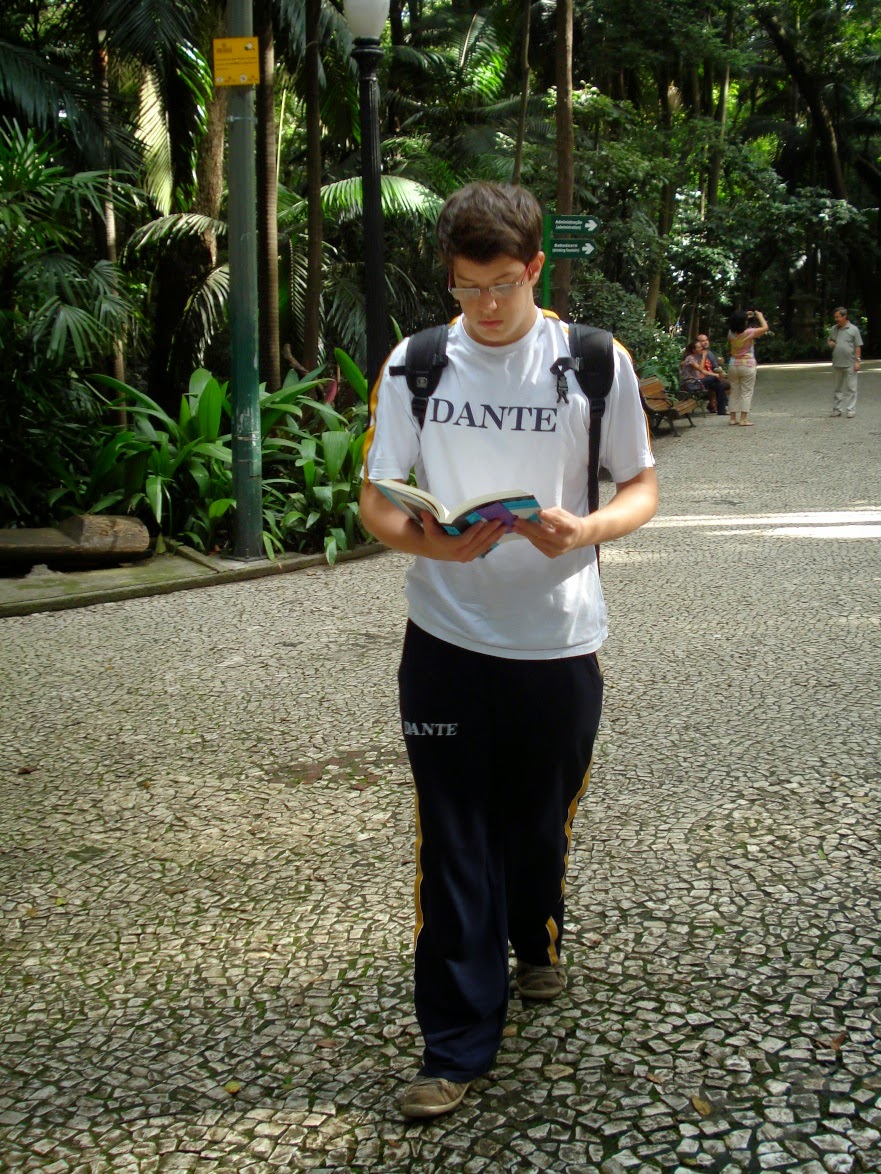
Em frente ao Museu de Arte de São Paulo, no outro passeio da Avenida Paulista, existe um pequeno jardim que chamam de Trianon. Vinda da Livraria Cultura do Conjunto Nacional, foi aí que quis sentar-me um pouco para fugir ao calor da tarde e atualizar o diário da viagem que tenho vindo a escrever. Ia em direção a um banco quando passou por mim o Manuel que, vestido com a farda do colégio que frequenta, lia enquanto caminhava. Dei meia volta sobre os calcanhares e fui tocar-lhe no ombro. O livro que lia era o segundo volume de “1Q84, de Haruki Murakami, uma obra que lhe foi recomendada pelo pai, que já leu os livros quase todos deste autor. E o Manuel não estava nada desiludido. “Gosto da maneira como o autor escreve, da originalidade da história. A dualidade entre os personagens principais, que são muito carismáticos, está muito bem conseguida e equilibrada, e um dos pontos mais interessantes é o entrosamento gradual entre ambos. Para além disso, o autor consegue instigar a curiosidade do leitor. Ao terminar os capítulos sempre deixa algo suspenso”, explicou-me de forma muito expressiva este jovem leitor de quem eu não esperava uma análise tão ponderada. Fiquei impressionada! É tão bom ver gente nova a ler e a pensar seriamente sobre o que lê. E o Manuel lê imenso. Quando lhe perguntei sobre os seus hábitos de leitura, respondeu-me dizendo que na véspera tinha comprado cinco livros. Conseguiu lembrar-se dos títulos de quatro: “1984”, “A Laranja Mecânica”, “E as Montanhas Ecoaram” e o último volume de “1Q84”. E o livro da sua vida? Talvez “O Rapaz do Pijama às Riscas”. “Interesso-me muito por livros sobre a história dos judeus na Segunda Guerra Mundial”, rematou.

***
In front of the São Paulo Art Museum, on the other sidewalk of Paulista Avenue, there is a small garden called Trianon. Coming from the Cultura bookstore in the Conjunto Nacional building, I decided to sit down for a while in the garden to escape the hot afternoon and update the travel log I have been writing. I was going towards a bench when Manuel passed by me, reading while walking, dressed in the uniform of the college he attends. I turned over my heels and touched his shoulder. The book he was reading was the second volume of "1Q84", by Haruki Murakami, a work recommended by his father, who have read almost all the books from this author. And Manuel was not at all disappointed. "I like the way the author writes, the originality of the story. The duality between the main characters, who are very charismatic, is highly accomplished and balanced, and one of the most interesting points is the gradual bond between both of them. Besides, the author can instigate the curiosity of the reader. When ending the chapters he always leaves something unconcluded", explained this young reader in a very expressive manner from whom I didn't expect such a careful analysis. I was impressed! It is so good to see young people reading and seriously thinking about what they are reading. And Manuel reads a lot. When I asked him about his reading habits, he answered that the day before he had bought five books. He managed to remember the title of four: "1984", "A Clockwork Orange", "And the Mountains Echoed", and the last volume of "1Q84". What about the book of his life? Maybe “Boy in the striped pyjamas”. “Books about Jew's History in World War Two interest me very much", he concluded.

quinta-feira, 24 de abril de 2014

São Paulo — Isis & Osho


A história é sobejamente conhecida. No fim da década de 30 do século passado, a família Herz chega ao Brasil para escapar à fúria do Terceiro Reich. Em São Paulo encontram uma comunidade alemã sedenta de livros no seu idioma e a matriarca da família, Eva, começa a alugar os poucos volumes que tinha levado consigo para a outra margem do Atlântico. Aos poucos, o acervo de livros disponíveis, quer em alemão quer em português começa a crescer e o negócio que tinha começado em casa muda-se para um espaço comercial. Em 1947 é formalmente fundada a Livraria Cultura, uma referência no panorama empresarial e cultural do país. No meu périplo pelo Brasil, já tinha tido a oportunidade de visitar outras livrarias Cultura, mas a que eu mais queria conhecer era a loja de São Paulo que fica no Conjunto Nacional, um edifício na Avenida Paulista, e que é a maior livraria do país, com uns impressionantes 4.300 m2. Mal entrei, parecia uma criança numa loja de doces: havia tanta gente, mas tanta gente a ler nos mais variados cantos da livraria que nem sabia a quem pedir uma fotografia. Decidi vaguear um pouco pelo espaço, até que vi uma jovem que lia sentada na barriga do grande dragão em madeira que decora a área de livros infantojuvenis. A Isis é doutoranda em linguística, por isso tem de ler muito sobre a sua área de estudo, mas o livro que lia quando a abordei era, nas suas palavras, "um momento de lazer, um momento para esvaziar a cabeça de tanta teoria e voltar a encará-la mais tarde com outro olhar". A sua atenção estava focada em "Inteligência — A Resposta Criativa no Agora", uma obra de Osho de quem tenta ler todos os livros que encontra. Não me soube explicar exactamente por que razão o tinha escolhido, apenas "queria ver como é que Osho vê a inteligência que não surge do ponto de vista do intelecto, mas sim a inteligência que já nasce com o ser humano, a inteligência mais ligada à sabedoria." Para além de Osho, a Isis é leitora assídua dos textos de Yogananda, mas a sua preferência literária vai definitivamente para os autores brasileiros, nomeadamente Machado de Assis, Cecília Meireles e Monteiro Lobato. E destacou, também o seu gosto pela literatura infantil com a qual está relacionada a sua tese de mestrado. Foi então que percebi porque se encontrava a Isis na barriga do dragão.

Podem ver mais fotos desta leitora e da livraria aqui.

***
The story is well known. At the late 30's from the past century, the Herz family arrives to Brazil to escape from the anger of the Third Reich. In São Paulo they find a German community eager of books on their own language and the matriarch of the family, Eva, starts lending the few volumes she had taken with her to the other side of the Atlantic. Little by little, the available collection of books, in German or in Portuguese, starts growing and the business once started at home had to move to a commercial space. In 1947 Cultura bookstore is formally founded, a reference in the business and cultural scene of the country. In my tour around Brazil, I already had the chance to visit other Cultura bookstores, but the one I most wanted to visit was the store from São Paulo, situated at Conjunto Nacional, a building in Paulista Avenue, which is the biggest bookstore of the country, with an impressive 4.300 square meters. As soon as I walked in, I was like a kid in a candy store: there were so many, really so many persons reading in the several corners of the bookstore that I didn't know to whom ask for a photo. I decided to wander around the place for a while, until I saw a young woman sitting on the belly of the big wooden dragon that decorates the children and teenage book area. Isis has a PhD in linguistic, so she has to read a lot about her study area, but the book she was reading when I approached her was, in her own words, "a moment of leisure, a moment to clear my head from so many theory and go back to it later with a fresh new perspective". Her attention was focused in "Intelligence — The Creative Response to Now", by Osho, the author she tries to read all the books she can find. She couldn't explain exactly why she had chosen this book in particular, she just "wanted to see how Osho looks up to intelligence that doesn't come from the intellect point of view, but the intelligence present at the human being when he is born, the intelligence more connected to wisdom." Besides Osho, Isis is a regular reader of Yogananda texts, but her literary preference goes definitely to the Brazilian authors, mainly Machado de Assis, Cecília Meireles and Monteiro Lobato. And, she also highlighted her taste for children's literature, which is related to her Master's thesis. That was when I understood why Isis was in the dragon belly.

More pictures of this reader and of the bookstore, here.

domingo, 20 de abril de 2014

Baía de Guanabara — Arnaud, em busca da felicidade
Guanabara Bay — Arnaud in search for happiness


No ferry que me levou de volta ao Rio de Janeiro depois de ter visitado o Museu de Arte Contemporânea em Niterói, conheci o Arnaud, um jovem arquiteto que estava há dois meses na cidade carioca à procura de trabalho. Para grande surpresa minha o Arnaudt, francês de gema, falava português corretamente graças às aulas que frequentou em Paris. Contou-me que o seu objetivo era ficar mais um mês no Rio e que se não conseguisse encontrar trabalho teria de se resignar e voltar para casa. Percebi que o faria com muita pena, porque no decorrer da nossa conversa me disse que achava extremamente sedutor ter uma oportunidade de trabalho no Brasil. Abordei-o porque o vi a ler, como é claro. O livro que tinha consigo era "Trop intelligent pour être heureux ? L'adulte surdoué", uma obra onde a autora levanta a hipótese das pessoas com inteligência extrema serem exacerbadamente sensíveis o que acentua uma impressão de inadequação que as impede de ser felizes. Pedi ao Arnaudt que me explicasse o motivo desta leitura, mas respondeu-me que não se sentia muito à vontade para falar sobre o assunto. Não foi por isso que a nossa conversa ficou por aí. Havia tantas outras coisas sobre as quais conversar! E assim fomos, em amena cavaqueira sobre outras coisas que não livros, até atracarmos no Rio de Janeiro. 
***
On the ferry that took me back to Rio de Janeiro after visiting the Contemporary Art Museum in Niterói, I met Arnaud, a young architect who has been looking for work in Rio de Janeiro for the last two months. For my surprise Arnaud, a genuine French, speaks Portuguese correctly thanks to the classes he took in Paris. He told me that his goal is to stay in Rio one more month and if he doesn't find work he will have to give up and go back home. I understood he would do it with real pity, because during our talk he told me that a job opportunity in Brazil is extremely appealing to him. Of course, I approached him because I saw he was reading. The book he had with him was "Trop intelligent pour être heureux? L' adulte surdoué" (in a free translation to English “Too Intelligent to be Happy? The highly-gifted adult”), a work where the author defends that people with extreme intelligence are also exaggeratedly sensitive which accentuates a feeling of being inappropriate and stops them of being happy. I asked Arnaud to explain me the reason why he was reading this book, but he answered me he didn't felt comfortable to talk about it. But that was not the end of our conversation. There are so many other things to talk about! And so we went, in a pleasant chat about other things than books until we docked at Rio de Janeiro.